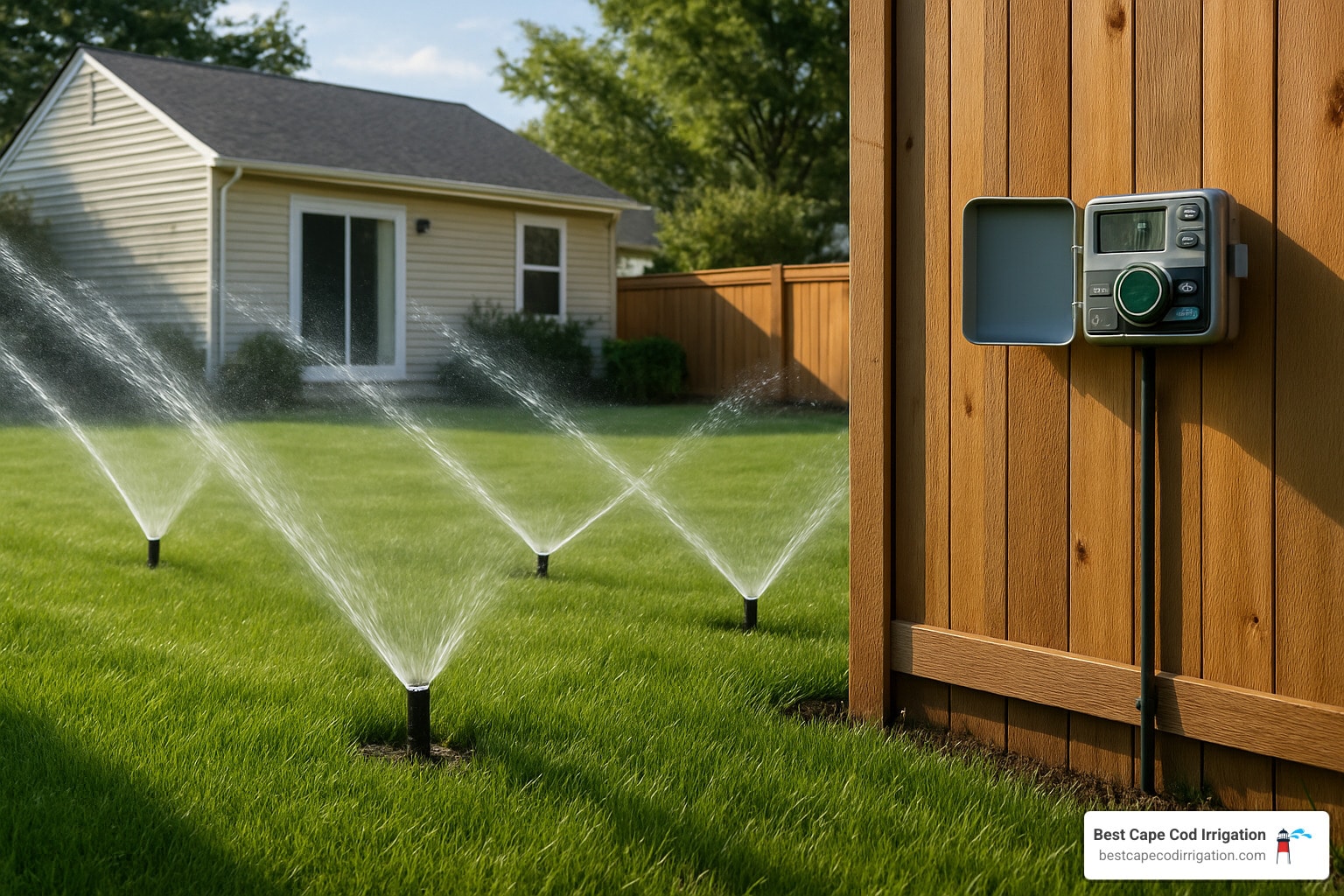



Why Timed Irrigation Systems Are Game-Changers for Cape Cod Homeowners
A timed irrigation system automatically waters your lawn and garden on a preset schedule, eliminating manual watering and preventing both overwatering and drought stress. Here’s what you need to know:
Top Types of Timed Irrigation Systems:
- Manual timers – Basic dial timers ($13-$30) for single-zone watering
- Battery-powered timers – Programmable schedules with multiple daily cycles ($30-$80)
- Electronic zone controllers – Multi-zone systems with rain sensors ($80-$200)
- Smart Wi-Fi timers – Weather-based scheduling with app control ($150-$335)
- Solar-powered systems – Off-grid solutions with battery backup ($75-$150)
Key Benefits:
- Save 20-30% on water bills through precise scheduling
- Eliminate daily watering chores and vacation plant stress
- Prevent overwatering damage to roots and landscaping
- Automatically adjust for rain and seasonal changes (smart models)
Have you ever driven by a house and saw the sprinkler system watering the lawn while it was raining? That’s exactly the problem timed irrigation systems solve. Research shows that controlled drip irrigation systems can reduce water loss with timing accuracy errors of just 0.9%, making them incredibly efficient for Cape Cod’s sandy soil and unpredictable weather patterns.
The convenience factor is huge too. Instead of dragging hoses around your yard every morning or worrying about your plants while you’re away, a timed system handles everything automatically. You set it once, and it keeps your landscape healthy year-round.
Cape Cod homeowners especially benefit from timed systems because our sandy soil drains quickly, requiring frequent but precise watering. Manual watering often leads to either drought-stressed plants or water waste from overwatering.
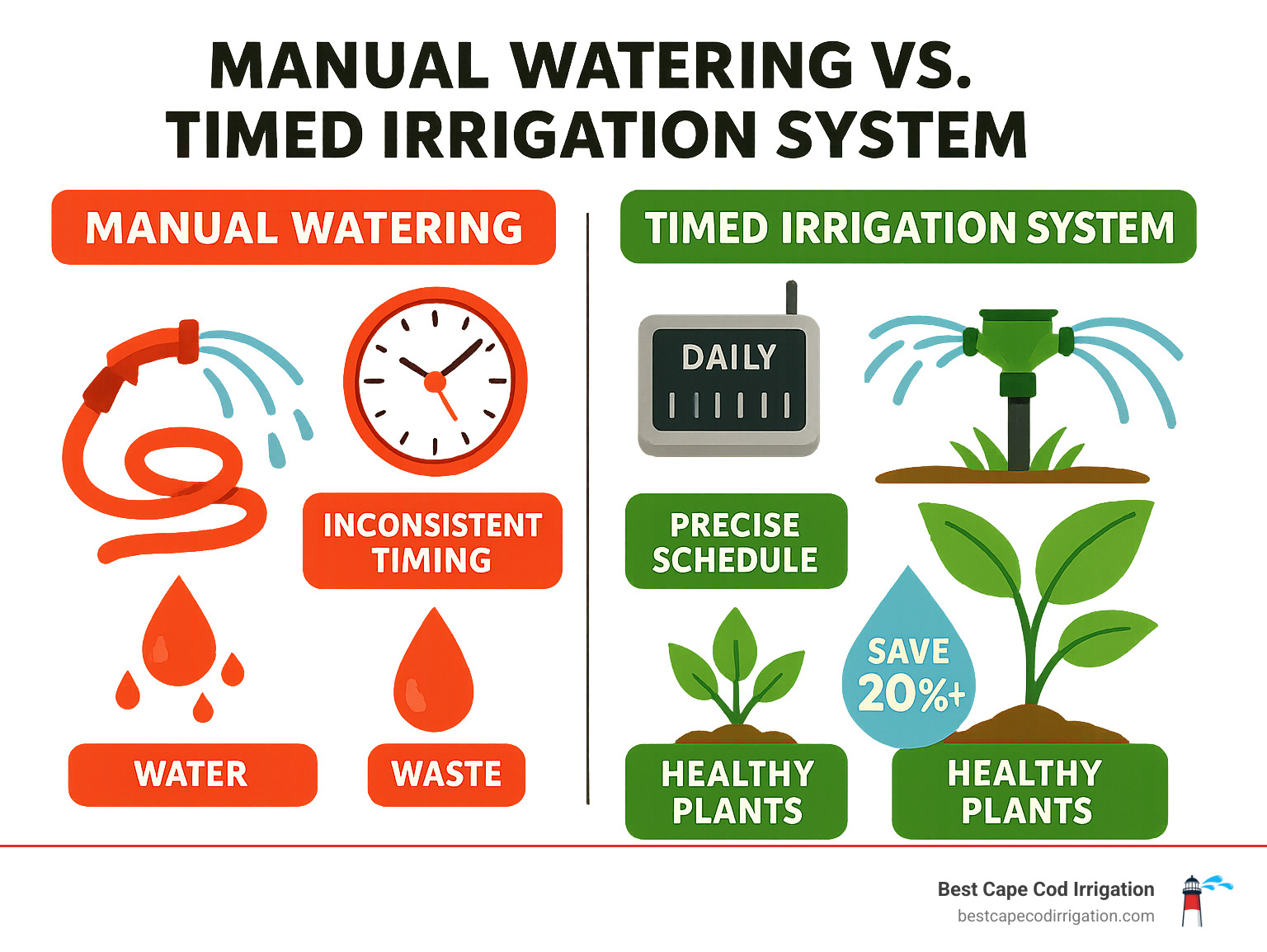
Timed irrigation system terms to learn:
Timed Irrigation System 101: How It Works, Types & Benefits
Think of a timed irrigation system as your personal watering assistant that never forgets, never oversleeps, and never goes on vacation. These clever devices control when and how long water flows to your plants, taking the guesswork out of keeping your Cape Cod landscape healthy and green.
Manual Timers: Your Gateway to Automated Watering
Manual timers are the perfect starting point for irrigation automation. These mechanical workhorses attach directly to your outdoor faucet and use a simple dial to control watering duration – typically up to 45 minutes per cycle.
What makes manual timers so appealing is their no-nonsense approach. There’s no programming to figure out, no batteries to replace, and no confusing digital displays. You simply twist the dial to your desired watering time, and the timer automatically shuts off when finished. For around $13-$30, you get reliable automation that’s perfect for single-zone applications like a vegetable garden or flower bed.
Battery-Powered Timers: Step Up to Smart Scheduling
When you’re ready for more flexibility, battery-powered timers offer programmable precision that manual timers can’t match. These units let you set multiple watering cycles per day, create different schedules for different days of the week, and control duration down to the minute.
Most models run on standard AA batteries and can operate for months before needing replacement. Many include rain delay features that pause watering during wet weather – a godsend during Cape Cod’s unpredictable summer storms. You’ll typically invest $30-$80 for this level of control, and the water savings often pay for the timer within a single growing season.
Electronic Zone Controllers: The Multi-Tasking Masters
Here’s where things get exciting for homeowners with diverse landscaping needs. Electronic zone controllers can manage 4-12 different watering zones, each with completely custom schedules. This means your thirsty vegetable garden can get daily attention while your established shrubs receive water every other day.
The real magic happens with zone-specific control. Your sunny front lawn might need 20 minutes of water three times weekly, while your shaded hostas only need 10 minutes twice a week. Electronic controllers make this level of customization effortless, typically costing $80-$200 depending on the number of zones and features.
Smart Wi-Fi Controllers: Weather-Intelligent Watering
Smart Wi-Fi timers represent the cutting edge of irrigation technology. These systems integrate real-time weather data to automatically adjust watering schedules. When rain is forecasted, they delay watering. During heat waves, they increase frequency. This weather-based scheduling can reduce water usage by 30-50% compared to fixed schedules.
App control means you can monitor and adjust your irrigation from anywhere. Forgot to turn off the sprinklers before leaving for vacation? Just grab your phone and make the adjustment remotely. Many models are voice assistant ready, so you can ask Alexa or Google to water your garden. Expect to invest $150-$335 for these sophisticated systems.
Solar-Powered and Gravity-Fed Solutions: Off-Grid Innovation
For environmentally conscious homeowners or those with remote garden areas, solar-powered systems combine sustainability with functionality. These typically include a solar panel, rechargeable LiFePO4 battery, and timer controller. The solar panel charges the battery during the day, providing power for automated watering cycles.
Gravity-fed systems offer the ultimate in simplicity and reliability. Using lifted water storage like a rain barrel on a platform, these systems create water pressure through gravity alone. Combined with simple timers, they create fully automated irrigation without electricity or complex pumps.
Real Benefits: Water Savings and Root-Zone Health
Timed irrigation systems deliver water directly to plant root zones, minimizing losses from evaporation, runoff, and overspray. Unlike hand watering that often misses target areas or overwaters others, timers provide consistent, measured water delivery.
Multi-zone control allows you to match watering schedules to plant needs. Your roses get different treatment than your lawn, and your drought-tolerant perennials get watered separately from your annual flower beds. This precision prevents both plant stress and water waste.
Consistent watering schedules also promote healthier plant growth. Plants develop stronger root systems when they receive regular, predictable moisture rather than sporadic heavy watering followed by dry periods.
Average costs range from $13 for basic manual timers up to $335 for sophisticated smart controllers – these are typical market prices based on internet data, not specific service costs. Most Cape Cod homeowners find their sweet spot between $50-$150 for systems that provide excellent functionality without unnecessary complexity.
For more information about maximizing water efficiency in your irrigation system, check out our guide on Water Efficient Sprinklers.
Best Timed Irrigation System Picks for 2024
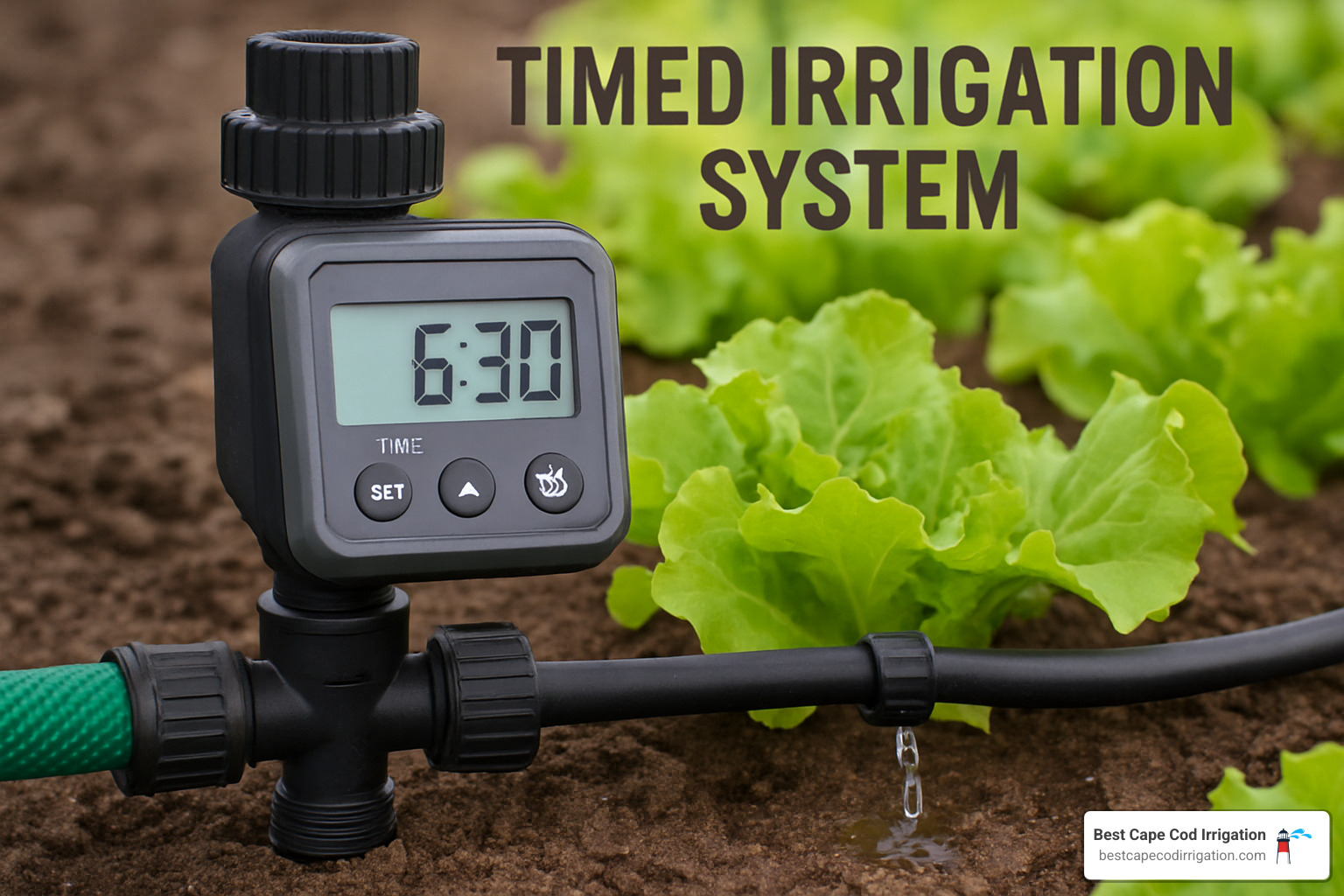
The beauty of today’s irrigation market is that there’s truly something for every budget and need. Whether you’re looking to automate a small herb garden or manage a sprawling landscape with multiple zones, the right system is out there waiting for you.
Budget Timed Irrigation System Under $50
Sometimes the simplest solutions work best. If you’re new to automated watering or just need to keep a small garden happy, budget-friendly timers under $50 deliver impressive functionality without breaking the bank.
These entry-level dial timers typically connect right to your outdoor faucet with a simple screw-on attachment. No complicated wiring, no electrical work – just attach, set, and forget. The hose-end setup means you can have automated watering running in under five minutes.
Most budget models handle single zone applications perfectly. Your vegetable garden, flower bed, or collection of containers can all receive consistent daily schedule watering without you lifting a finger. The timer does its job, shuts off automatically, and your plants stay happy.
The real magic happens when you go on vacation. Instead of bribing neighbors to water your plants or coming home to crispy tomatoes, your budget timer keeps everything thriving. It’s amazing how much peace of mind twenty-five dollars can buy.
Smart Timed Irrigation System with Weather Intelligence
Smart irrigation controllers represent the future of home watering systems. These Wi-Fi controllers connect to weather services and automatically adjust your watering schedule based on real-time conditions – pretty neat stuff.
The app control feature transforms how you manage your irrigation. Check system status from the office, adjust schedules while traveling, or receive alerts about system issues. Some homeowners love being able to show off their smart system to friends by controlling their sprinklers with voice commands through voice assistant compatibility.
But the real star is weather-based scheduling. When rain is forecasted, the system automatically delays watering. During hot, dry spells, it increases frequency to keep plants healthy. This intelligent approach can reduce water usage by 30-50% compared to fixed schedules – your water bill will thank you.
The learning curve is surprisingly gentle. Most smart controllers guide you through setup with step-by-step instructions, and the apps are designed for regular homeowners, not tech wizards.
Multi-Zone Powerhouse for Large Landscapes
Large properties with diverse planting areas need serious control systems. Multi-zone controllers managing 8-12 zone capabilities handle complex landscapes where different plant types have completely different water needs.
The modular expansion feature means you can start with six zones and add more later as your landscape grows. Your vegetable garden might need daily watering, established trees weekly deep watering, and flower beds something in between. These controllers make this level of customization straightforward.
The rain-delay button provides quick weather adjustments when you see storm clouds rolling in. The seasonal adjust feature lets you reduce all zones by a percentage in fall or increase them during summer heat waves – one simple adjustment affects your entire system proportionally.
Professional-grade features like battery backup maintain programming during power outages, and robust weather-resistant enclosures handle Cape Cod’s coastal weather conditions. Installation typically requires basic electrical knowledge, though many homeowners successfully tackle it themselves.
Off-Grid Solar & Gravity-Fed Solutions
Remote locations, eco-conscious homeowners, or areas without reliable electricity can still enjoy automated irrigation through solar and gravity-fed systems. These solutions prove that you don’t need grid power for sophisticated watering control.
Solar drip kits typically include weather-resistant solar panels rated for 5+ years of reliable operation. LiFePO4 battery technology supports 2000+ charge cycles, providing years of dependable power storage. Some systems include soil moisture sensors for demand-based watering – the system only waters when plants actually need it.
Gravity header tanks offer the ultimate in simplicity and reliability. A 300-liter lifted tank provides sufficient pressure for extensive drip irrigation systems. The beauty of gravity systems is their fail-safe nature – no power outages, no pump failures, no electronic malfunctions.
Low-tech clay valve systems represent the most basic automation possible. These simple devices slowly release water as soil dries, providing continuous plant care without any external power source. They’re perfect for vacation watering or remote garden locations where running power would be impractical.
Installing & Programming Your Timer
Getting your timed irrigation system up and running is easier than you might think, though the complexity varies depending on which type you choose. Whether you’re connecting a simple hose-end timer or wiring a multi-zone controller, we’ll walk you through everything you need to know.
Site Assessment and Planning
Before you start screwing anything together, take a walk around your property with a notepad. You’ll want to map out your landscape’s personality – and yes, every yard has one! Notice which areas bake in the sun all day (these are your thirsty zones) and which spots stay cool under tree cover.
Cape Cod’s sandy soil drains faster than a bathtub with the plug pulled, which means your plants need shorter, more frequent drinks rather than long, soaking sessions. This is crucial information for programming your timer later.
Identify your different plant types and their water needs. Your established oak tree and your new tomato seedlings have completely different requirements.
Mounting Location and Connections
For hose-end timers, your mounting location is pretty much decided for you – wherever your outdoor faucet lives. But for wall-mounted controllers, choose a spot that’s easily accessible for programming but won’t get hammered by rain or baked by direct sun.
Here’s something that might save you a headache later: always include a backflow preventer in your installation. This little device prevents irrigation water from flowing back into your drinking water system. It’s not just a good idea – it’s required by code in most areas.
Basic Wiring and Connections
Multi-zone systems require some basic wiring between the controller and each zone’s valve. Use direct-burial irrigation wire rated for outdoor use, typically 18-gauge wire for runs up to 200 feet.
The secret to long-lasting connections is using waterproof wire nuts filled with silicone gel. Regular wire nuts will corrode faster than a beach chair left out all winter.
For hose-end systems, make sure all connections include rubber gaskets to prevent leaks. Hand-tighten everything firmly, but resist the urge to crank down with pliers – you’ll damage the threads or gaskets.
Flow Testing and Programming Schedules
Before you program your final schedule, run some flow tests to see how your system actually performs. Start with dry soil conditions and time how long it takes to achieve good moisture penetration without creating puddles or runoff.
Start conservative with your watering schedules – you can always increase frequency if plants look stressed. Most Cape Cod landscapes thrive with established lawns getting 3 sessions per week at 15-20 minutes per zone, while new plantings need daily attention for 10-15 minutes. Established shrubs typically do well with twice-weekly watering for 20-30 minutes, and vegetable gardens usually need daily watering for 10-20 minutes depending on what you’re growing.
Many timers start their first cycle 24 hours after initial programming. If you set up your system Tuesday morning expecting immediate watering, you might be waiting until Wednesday morning.
Maintenance and Battery Replacement
Battery-powered timers typically need fresh batteries every 6-12 months, depending on how often they’re running and the quality of batteries you use. Keep spare batteries on hand and mark your calendar for regular replacement.
Clean timer displays and controls regularly to prevent dirt and debris from gumming up the works. Most units are weather-resistant but appreciate occasional cleaning with a damp cloth.
| Timer Type | Setup Time | Complexity Level | Programming Features |
|---|---|---|---|
| Manual | 5 minutes | Beginner | Duration only |
| Battery-powered | 15 minutes | Intermediate | Multiple daily cycles, weekly scheduling |
| Electronic zone | 45 minutes | Advanced | Multi-zone, seasonal adjust, rain delay |
| Smart Wi-Fi | 30 minutes | Intermediate | App control, weather integration |
For more detailed guidance on professional installation techniques, check out this Scientific research on water-saving timers or learn more about our Irrigation System Installation services.
Smart Features, Water Savings & FAQs
Modern timed irrigation systems have evolved into sophisticated water management tools that do much more than turn sprinklers on and off. These smart features can transform your Cape Cod landscape from a water-wasting worry into an efficient, self-managing garden paradise.
Rain and Soil Sensors
Picture this: you’re enjoying your morning coffee when storm clouds roll in, but instead of rushing outside to turn off your sprinklers, you relax knowing your rain sensor has already paused the system. These clever devices mount right on your controller and detect rainfall through expanding discs or electronic sensors.
Soil moisture sensors take things even further. These underground monitors check your soil’s actual moisture levels, watering only when your plants genuinely need it. Some advanced solar-powered systems use indirect soil moisture sensing, placing sensors near plants rather than buried in the dirt, which means less maintenance and more reliable readings.
Weather-Sync Algorithms
Smart controllers connect to weather services and become your landscape’s personal meteorologist. They automatically adjust watering schedules based on current temperature and humidity, wind speed, rainfall forecasts, and even historical weather patterns for your specific area.
This weather intelligence can slash your water usage by 30-50% compared to those old “set it and forget it” schedules. During Cape Cod’s cool, humid spring days, the system dials back watering. When those hot July heat waves hit, it automatically increases frequency.
EPA WaterSense Rebates and Remote Control
Many water utilities offer rebates for WaterSense-certified irrigation controllers that can cover 25-50% of your equipment costs. Before you buy, check with your local Cape Cod water utility about available rebates.
App-based control has transformed irrigation from a daily chore into occasional fine-tuning from your smartphone. Monitor system status from anywhere, get alerts about issues, and adjust schedules whether you’re stuck in traffic or relaxing on vacation.
Troubleshooting and ROI
When your timer display goes blank, dead batteries are the culprit 80% of the time. Keep spare alkaline batteries handy – it’s the quickest fix you’ll ever make.
Inconsistent watering usually means clogged emitters or low water pressure. A quick cleaning typically solves the problem.
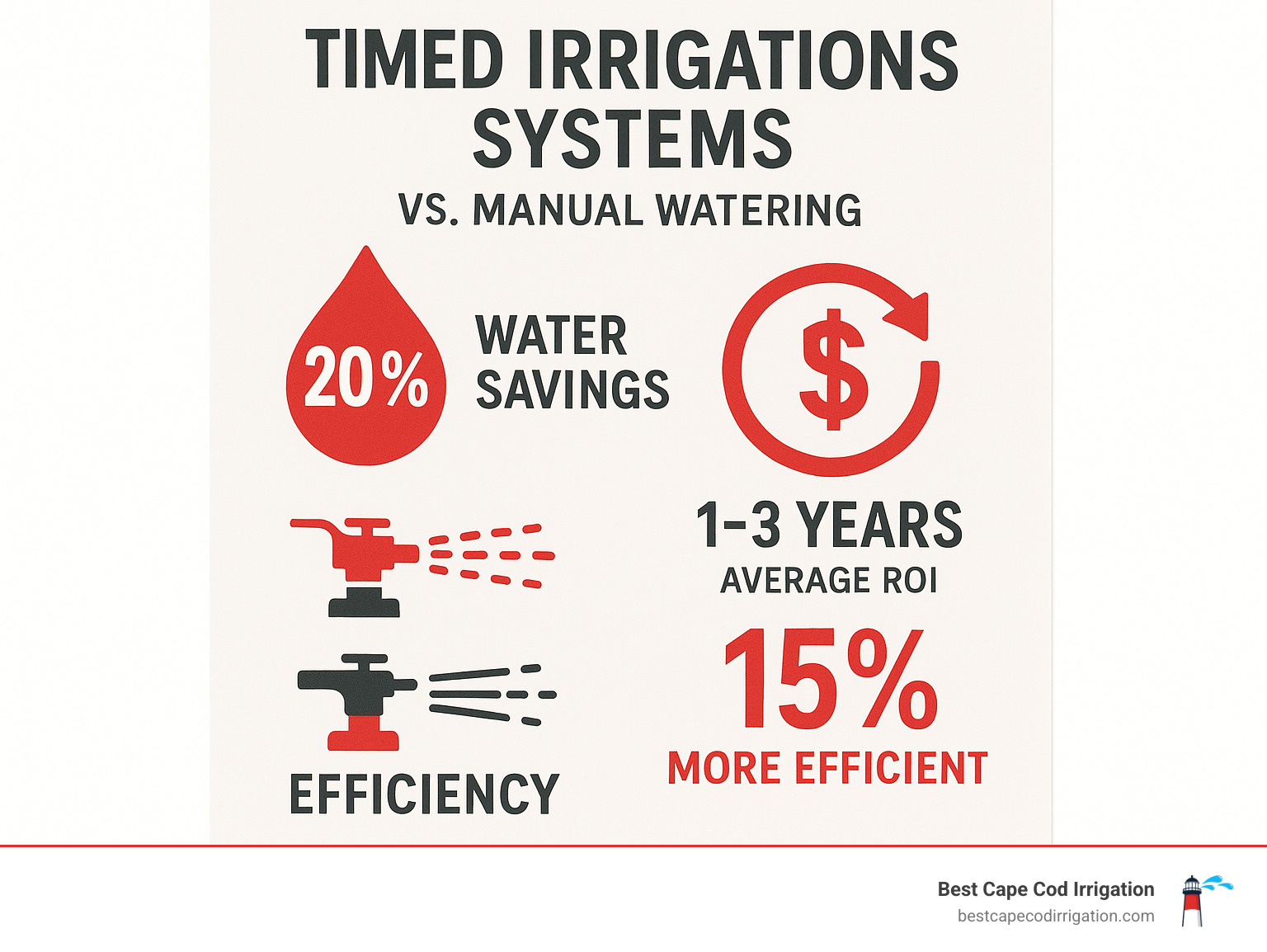
Most homeowners see their timed irrigation system pay for itself within 1-3 years through reduced water bills and healthier landscapes. Water savings of 20-30% are typical, with smart systems achieving even higher savings.
Research demonstrates that modern systems deliver incredible precision – timing accuracy errors of just 0.9% and solenoid valve response rates of 0.99, proving these systems are both smart and reliable.
For comprehensive smart irrigation solutions custom to Cape Cod conditions, explore our Smart Irrigation Solutions services.
Frequently Asked Questions about Timed Irrigation Systems
How often should I adjust schedules through the year?
Cape Cod’s changing seasons require four major schedule adjustments to keep your landscape healthy and your water bills reasonable.
Spring brings your plants out of winter dormancy, so start with 75% of your summer watering amounts in March through May. Summer is peak watering season from June through August when your full schedules kick in. Fall means gradually reducing watering as temperatures drop from September through November. Winter requires minimal or no watering for most plants from December through February.
Smart controllers handle many of these adjustments automatically through weather integration.
Can a timed system work with rain barrels or wells?
Absolutely! Rain barrel systems work beautifully with gravity-fed drip irrigation, especially when you lift your barrel 3-4 feet high for adequate pressure. Use pressure-compensating emitters and simple timer controls.
Well systems often work excellently with timed irrigation systems, but you’ll want to ensure your pressure tank sizing is adequate for irrigation demands and your pump capacity is sufficient for multiple zones.
What’s the quickest fix if my timer display goes blank?
Don’t panic – this happens to everyone! Dead batteries cause blank displays 80% of the time, so start by replacing them with fresh alkaline batteries.
If new batteries don’t solve it, check for loose connections at the controller terminals. Some controllers have replaceable fuses that protect against power surges, so check your manual for fuse location.
Keep spare batteries and basic tools handy for quick fixes. Most display issues can be resolved in under 10 minutes.
Conclusion
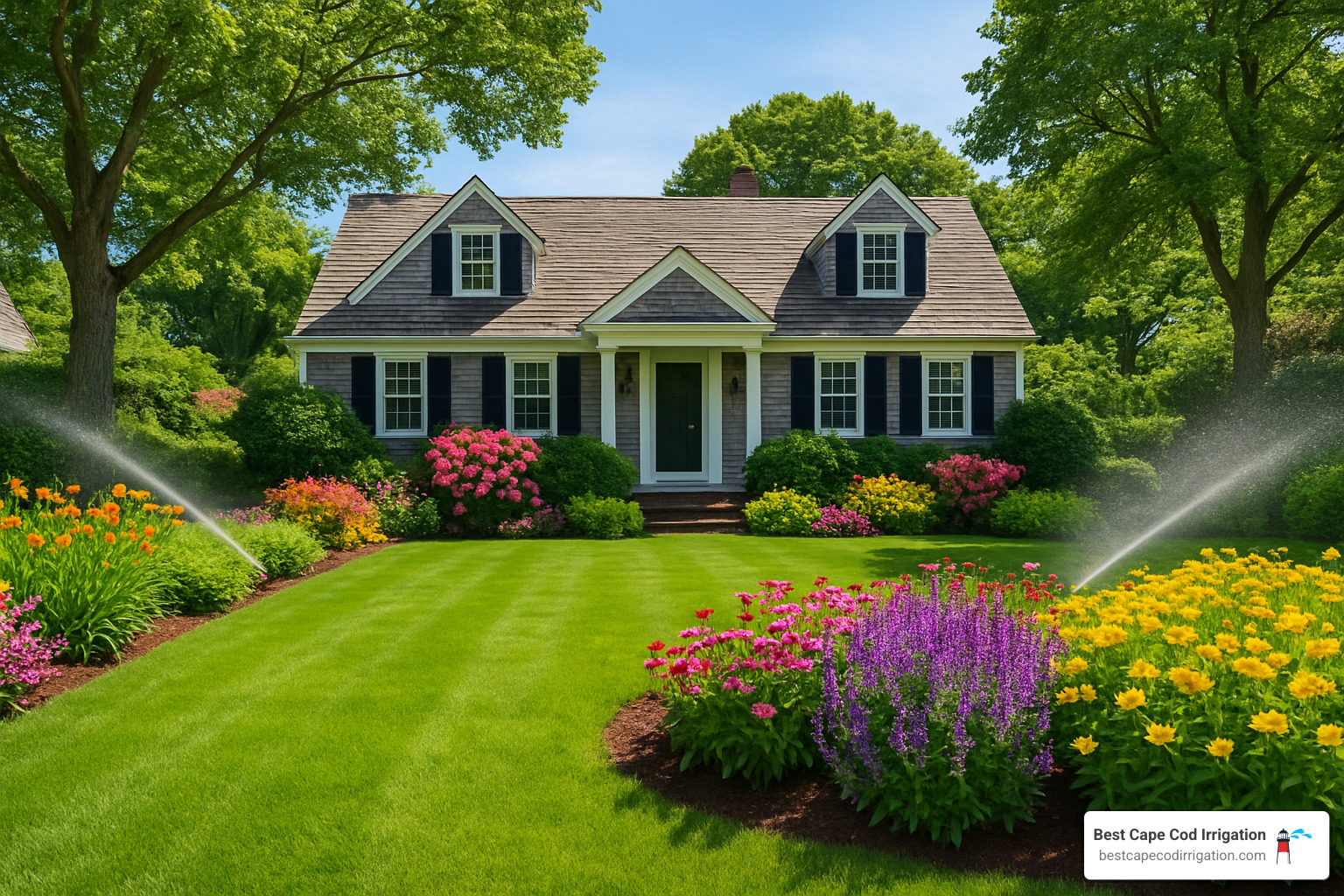
Your Cape Cod landscape deserves better than the daily hassle of dragging hoses around or watching your plants struggle during vacation. A timed irrigation system transforms your outdoor space from a chore into a source of pride – and the results speak for themselves.
Think about it: no more brown patches from missed watering days, no more water bills that make you wince, and definitely no more rushing home early from the beach to water your tomatoes. Whether you start with a simple $13 manual timer for your herb garden or invest in a $335 smart controller that thinks ahead of the weather, you’re making a choice that pays dividends every single day.
The water efficiency alone makes these systems remarkable. With timing accuracy that’s off by less than 1%, modern controllers deliver exactly what your plants need, when they need it. That translates to 20-50% water savings – money that stays in your pocket instead of soaking into Cape Cod’s sandy soil and disappearing.
But here’s what really matters: your plants will thank you. Consistent watering creates stronger root systems, lusher growth, and landscapes that bounce back from our unpredictable Cape weather. Your neighbors will notice the difference, and so will your property value.
The convenience factor can’t be overstated. Set your system once, and it handles everything while you enjoy your summer evenings on the deck instead of wrestling with sprinklers. Planning a long weekend in Boston? Your garden will be thriving when you return.
Most homeowners see their investment pay for itself within 1-3 years through lower water bills and healthier plants that don’t need constant replacement. The time savings start immediately – and let’s be honest, isn’t your weekend better spent at the beach than watering the lawn?
Timed irrigation systems represent smart environmental stewardship too. Precise water delivery eliminates waste, prevents overwatering damage, and helps preserve our precious Cape Cod water resources for future generations.
At Best Cape Cod Irrigation, we’ve watched countless homeowners transform their landscapes with properly installed automated systems. Our 25+ years of regional expertise means we understand exactly how Cape Cod’s unique climate and soil conditions affect your irrigation needs.
Ready to join the thousands of Cape Cod homeowners who’ve found the freedom of automated watering? Professional installation ensures your system performs optimally from day one and continues delivering reliable service for years to come. Learn more about our comprehensive Irrigation System Installation services and take the first step toward effortless, beautiful landscaping.